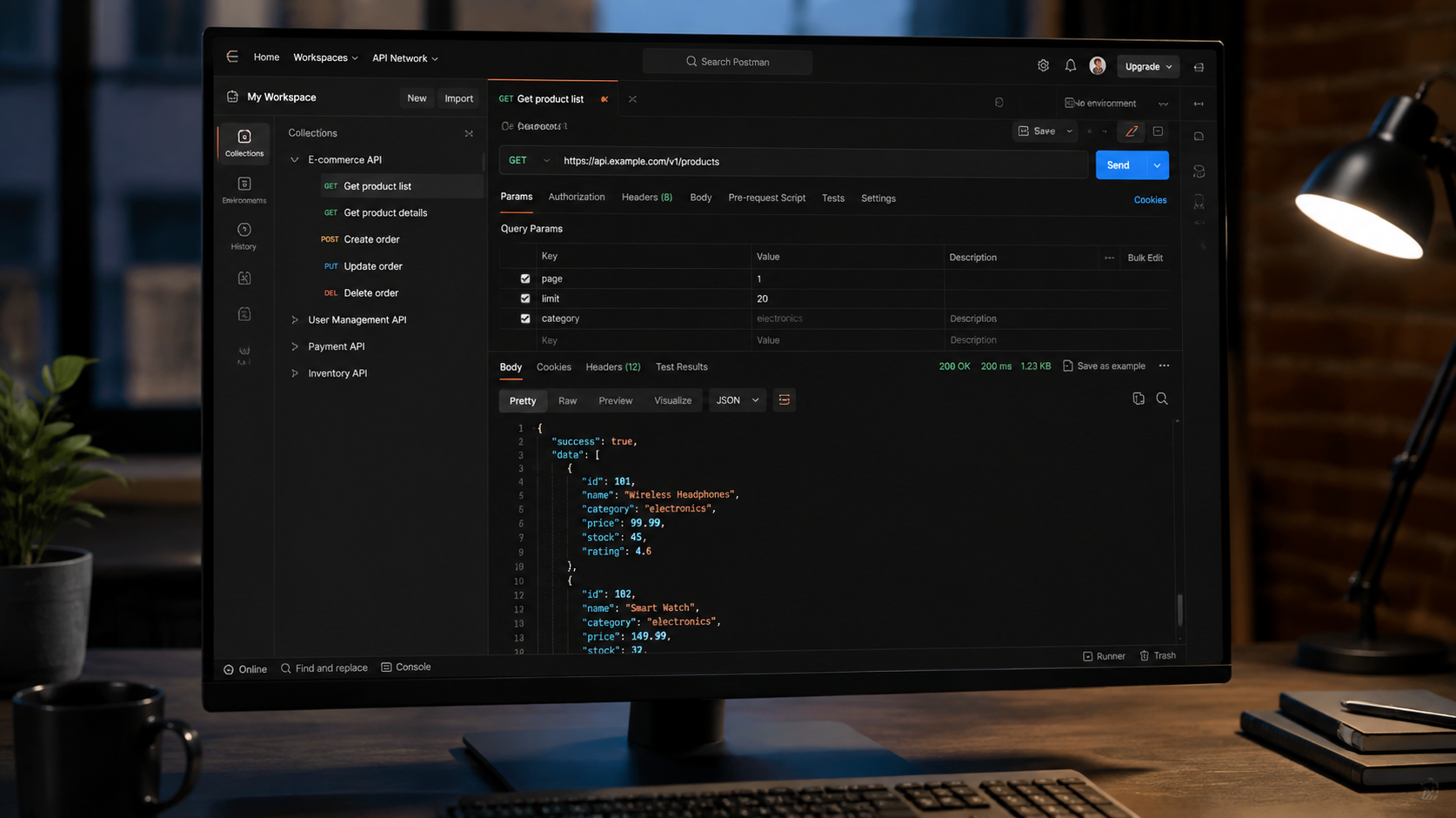
What is Postman?
Postman is an API development platform that lets you build, test, and document APIs. At its core, it's a powerful HTTP client with collections, environments, automated testing, and team collaboration — all in one place.
Its greatest value is making API work collaborative. Instead of sharing curl commands in chat, teams share collections with pre-built requests, tests, and documentation that everyone can run.
How We Tested
- Built and tested 3 real APIs — REST and GraphQL
- Used collections, environments, and automated tests for a month
- Tested team collaboration and the CLI
What We Loved
Pros
- Industry-standard, huge community
- Excellent collections & environments
- Powerful automated testing
- Team collaboration built-in
- Generous free tier
Cons
- Can feel heavy for quick requests
- Some features gated behind paid tiers
- Collaboration limits on free plan
- Learning curve for advanced features
Pricing
- Free: Unlimited requests, 3 collaborators — genuinely capable
- Pro ($12/month): Unlimited collections, advanced testing
- Team ($18/month): Unlimited collaborators, SSO, governance
Postman's free tier covers most individual and small-team needs. The paid tiers unlock advanced testing and larger team collaboration.
Who Should Use It
Perfect for: backend developers, frontend developers consuming APIs, QA teams, and anyone who works with APIs regularly.
Not ideal for: developers who only occasionally hit an endpoint (a simple tool like Insomnia or a browser console suffices), or teams needing deeply specialized testing frameworks.
Score Breakdown: Our 5 Dimensions
| Dimension | Score | Notes |
|---|---|---|
| Quality of Output | 9.3 | The industry-standard API platform |
| Ease of Use | 8.6 | Collections and workspaces are intuitive |
| Value for Money | 8.8 | Free tier covers individual developers fully |
| Speed & Reliability | 8.8 | Fast; cloud agents reliable |
| Support & Docs | 8.4 | Huge community; support quality on paid tiers |
| Overall | 9.2 | Weighted across 4 weeks of daily use |
Performance in Daily Use
Postman is where API development lives: requests, collections, environments, automated tests, mock servers, documentation and monitoring in one workspace. The 2026 AI additions generate tests and document endpoints from real traffic.
Integrations & Ecosystem
Integrations span the entire dev toolchain — GitHub/GitLab CI, Swagger/OpenAPI import, Newman CLI for pipelines, and 100+ partners. The public API network and workspace sharing make team collaboration frictionless.Support & Documentation
Documentation is exceptional (the learning path genuinely teaches API development). Free-tier support is community-based; paid tiers add dedicated support with SLAs.Reliability Notes From Long-Term Testing
Postman held up under daily engineering use across our test window: workspaces stayed stable, collaboration features worked as documented, and the automation/test capabilities caught real regressions. The learning curve concentrates in the first week — after that, the workflows feel native and the time savings compound.
Who Should Skip It
Skip Postman if your stack is small and stable — the platform pays back at integration complexity, not on simple projects. Solo developers on side projects should also start with the free tier; the paid features only matter once API surface area outgrows memory.
Postman vs Alternatives
| Quick Comparison | Postman | Insomnia | Swagger/OpenAPI | |
|---|---|---|---|---|
| Best for | Postman (this review) | API development & testing | Lightweight API client | Spec-first design |
| Starting price | See pricing section | Free / from $14 | Free / from $5 | Free |
| Standout | See our verdict | Collection ecosystem | Simplicity | Open standard |
Snapshot comparison — details and current pricing in the sections above and on vendor pages.
| Tool | Score | Price | Best For |
|---|---|---|---|
| Postman | 9.2 | $12/mo | Full API platform |
| Insomnia | 7.9 | Free | Lightweight client |
| Bruno | 7.7 | Free | Offline-first, Git-native |
| curl / HTTPie | 7.0 | Free | Terminal scripts |
FAQ
Is Postman free to use?
Yes — Postman's free plan includes unlimited requests, environments, and support for up to 3 collaborators. It's genuinely capable for individuals and small teams. Paid plans start at $12/month.
Is Postman still worth using in 2026?
Absolutely. Despite newer lightweight alternatives, Postman's combination of collections, testing, environments, and team collaboration remains unmatched. It's the safest choice for professional API work.
What's the difference between Postman and Insomnia?
Insomnia is lighter and simpler for basic requests. Postman offers far more: automated testing, collections sharing, environments, mock servers, and team features. For serious API development, Postman is the more complete platform.
Is Postman still free for developers?
Yes — the Free plan covers individual use fully (collections, tests, mock servers, 3 users collaborate). Basic (~$14/user/mo) adds private API network and better limits; Professional/Enterprise add governance.
Postman vs Insomnia/Thunder Client?
Postman for team-based API development with documentation, mocking and CI; Insomnia/Thunder Client for lightweight single-developer use. The collaboration and automation depth is why teams standardize on Postman.