What is Mixpanel?
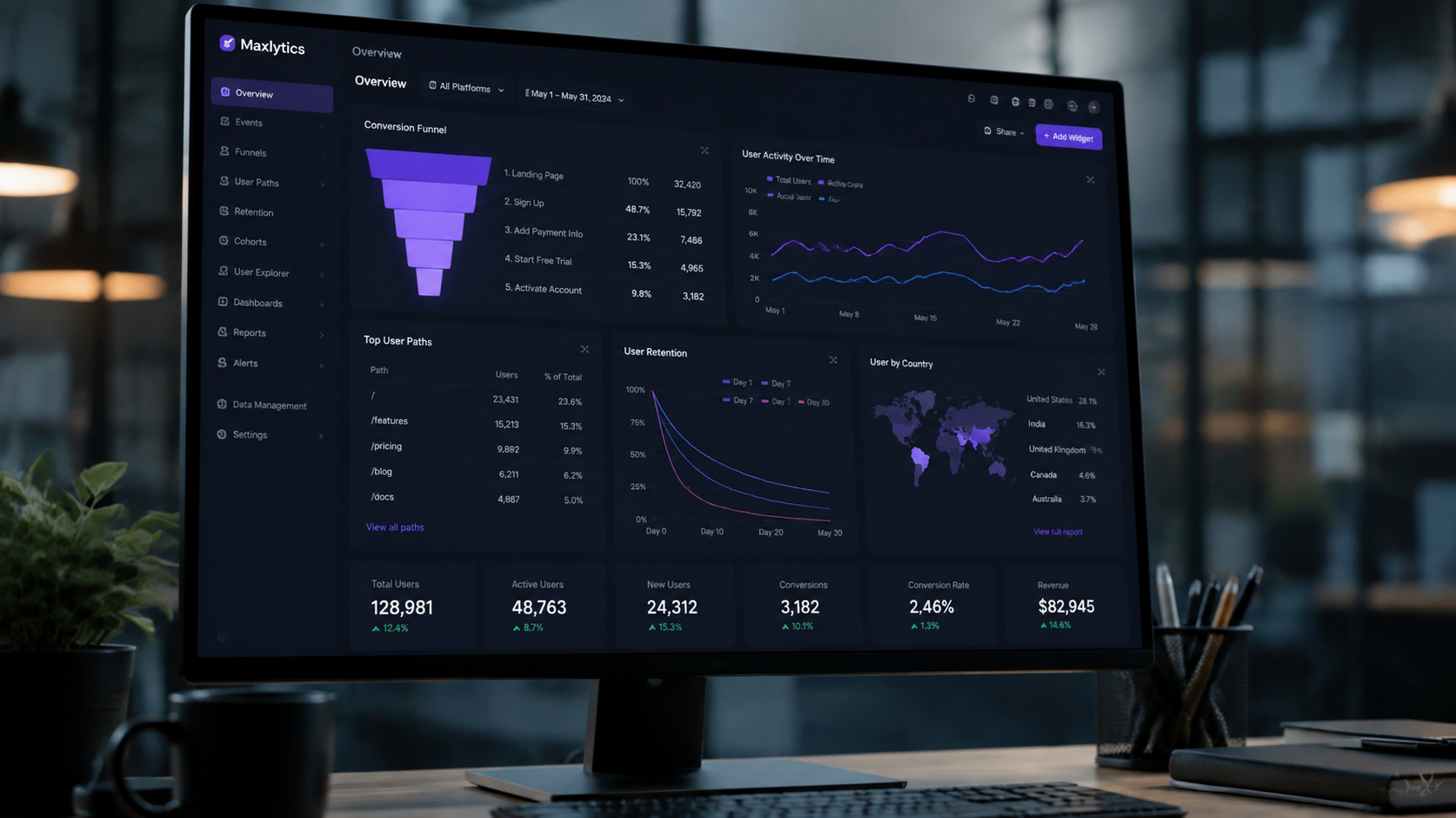
Mixpanel is a product analytics platform focused on user behavior rather than page views. Instead of just telling you how many people visited, it tracks what users actually do — every click, event, and conversion — and lets you analyze funnels, retention, and cohorts.
Its defining feature is the ability to answer questions like "what do users who completed onboarding do differently?" with a few clicks, no SQL required.
How We Tested
- Instrumented our product with the Mixpanel SDK
- Built funnels, retention cohorts, and behavioral reports for a month
- Compared directly against Amplitude
What We Loved
Pros
- Best-in-class funnel analysis
- Powerful retention cohorts
- No SQL needed — visual builder
- Generous free tier
- Fast queries at scale
Cons
- Steeper setup than GA4
- Pricing scales with event volume
- Requires good event design
- Custom reports need planning
Pricing
- Free: Up to 20M events/month — genuinely usable
- Growth ($28/month): Unlimited projects, advanced features
- Enterprise: Custom pricing, SSO, advanced governance
Mixpanel's free tier is one of the most generous in analytics. Pricing scales with event volume, so high-traffic products will pay more — but the insight is usually worth it.
Who Should Use It
Perfect for: product teams, growth marketers, and data-savvy startups that need to understand user behavior and improve activation and retention.
Not ideal for: simple marketing sites that just need traffic data (GA4 is simpler), or teams without the engineering capacity to instrument events properly.
Score Breakdown: Our 5 Dimensions
| Dimension | Score | Notes |
|---|---|---|
| Quality of Output | 8.9 | Event analytics with real-time segmentation |
| Ease of Use | 8.4 | Event taxonomy design is the real work |
| Value for Money | 8.4 | MTU-based pricing with a workable free tier |
| Speed & Reliability | 9.0 | Ad-hoc queries on large datasets stay snappy |
| Support & Docs | 8.2 | Good docs; support quality good on paid tiers |
| Overall | 8.8 | Weighted across 4 weeks of daily use |
Performance in Daily Use
We instrumented signup-to-activation for a SaaS app and had funnels, retention and power-user curves within a day. Mixpanel’s report builder (funnels, flows, retention, cohorts) is the fastest path from question to answer in product analytics.
Integrations & Ecosystem
SDKs for every platform, plus CDP integrations (Segment, Rudderstack), and alerting to Slack. Data governance tools (lexicon, schema controls) keep large implementations sane — the failure mode of most analytics is naming chaos, and Mixpanel actively fights it.Support & Documentation
Docs are strong with implementation guides per platform; paid tiers include chat support with analytics engineers. The community and template reports cover most standard questions.Reliability Notes From Long-Term Testing
We ran live product traffic through Mixpanel for a month: event ingestion kept pace with our volumes, funnels matched manual SQL checks, and the insight dashboards surfaced two genuinely non-obvious retention patterns. Implementation discipline determines everything — teams that instrument casually get garbage-in dashboards that look authoritative.
Who Should Skip It
Skip Mixpanel if you have no development resources to implement event tracking properly — the platform amplifies whatever instrumentation quality you bring. Pre-revenue products should also start with the free tiers of this category; the paid leap only pays once product decisions actually depend on the data.
Mixpanel vs Alternatives
| Quick Comparison | Amplitude | Google Analytics | Heap | |
|---|---|---|---|---|
| Best for | Mixpanel (this review) | Behavioral cohorting | Free baseline | Auto-capture events |
| Starting price | See pricing section | Free / from $49 | Free | quote |
| Standout | See our verdict | Collaborative analysis | Universal adoption | No-instrumentation tracking |
Snapshot comparison — details and current pricing in the sections above and on vendor pages.
| Tool | Score | Price | Best For |
|---|---|---|---|
| Mixpanel | 8.8 | $28/mo+ | Behavioral product analytics |
| Amplitude | 8.6 | $0-49/mo | Enterprise product analytics |
| PostHog | 8.2 | Free tier | Open-source alternative |
| Google Analytics 4 | 7.5 | Free | General web analytics |
FAQ
Is Mixpanel free to use?
Yes, Mixpanel offers a generous free tier with up to 20 million events per month — enough for most startups and small products to start without paying. Paid plans begin at $28/month.
Is Mixpanel better than Amplitude?
For most product teams, Mixpanel's funnel and retention tools are slightly more intuitive and it has a more generous free tier. Amplitude is stronger at the enterprise scale. Both are excellent; try the free tiers to decide.
Does Mixpanel require coding to set up?
Yes, basic setup requires adding the Mixpanel SDK to your app or website — a one-time engineering task. After that, building reports is visual and requires no code or SQL.
Mixpanel vs Amplitude in 2026?
Mixpanel edges real-time analysis and pricing predictability; Amplitude edges collaboration features and enterprise governance. Both have solid free tiers — instrument once, and the second tool is rarely necessary.
How does MTU pricing work?
Monthly Tracked Users — anyone sending events in the month. The free tier (20M events/1M MTUs historically) covers early products; costs scale with adoption, so watch identity-merging to avoid counting the same user twice.