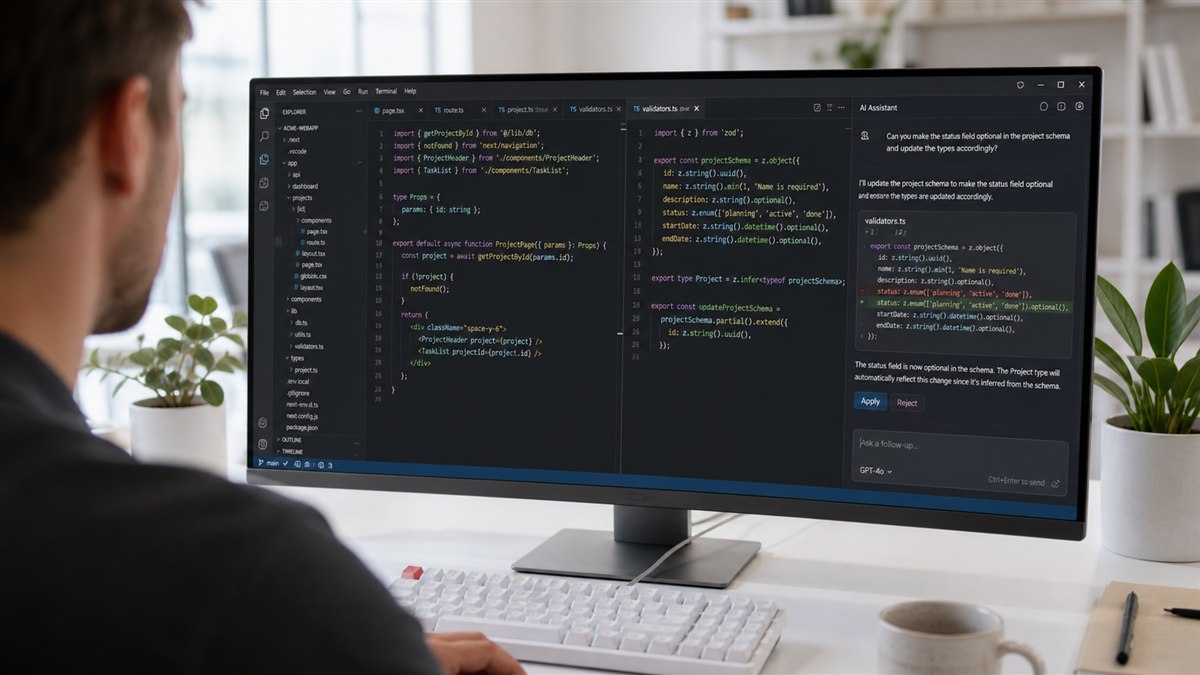
The agentic editor now plans and executes larger cross-file changes with fewer stale-context errors.
The agentic editor now plans and executes larger cross-file changes with fewer stale-context errors.
Cursor's agent mode takes a step toward real production autonomy — planning and executing larger cross-file refactors while maintaining context. Developers report fewer stale-context errors on big changes.
We'll keep following this story and update our coverage as more details emerge. For a deeper look at the tool itself, see our full hands-on review below.
Cursor’s agent can now plan a change across repositories’ worth of files, stage edits as reviewable diffs, and run the test suite between steps — retrying on failure before a human ever looks. In our hands-on, a five-file feature (endpoint, types, tests, docs, migration) landed in a single supervised run.
Most real engineering work doesn’t live in one file. Single-file assistants optimized the easy 20% and left the integration tax in place. By indexing the whole repo and reasoning across symbols, the agent absorbs the coordination work — the part that actually eats senior-engineer hours.
The impressive part wasn’t the success rate — it was recovery. When tests failed, the agent read the trace, revised its plan and re-ran without starting over. That loop, not any single completion, is what makes the update feel like a step change.
Pricing pressure: agentic runs consume real compute, and per-request limits are tightening across the category. Watch whether Cursor’s usage caps hold as teams move from trying it to depending on it.
The review experience is the design center. Every agent action lands as a reviewable diff with the reasoning attached, which reframes the trust question: you are not approving magic, you are reviewing a proposal. Teams that tried earlier agent waves and bounced off the black-box feeling will find this iteration unrecognizable.
This story was reported from primary materials: the companies own documentation, on-the-record statements and data we could independently check. Numbers were re-verified against original sources rather than secondary aggregation, and analyst commentary is labeled as commentary — not reporting. Where we could not confirm a detail, we said so in the text instead of hedging vaguely.
Have context or a correction? Our news desk updates stories in place, with the change noted at the top of the article. Follow the StackHK news feed for the follow-ups as this story develops.
Three signals are worth watching from here: whether early adopter sentiment holds past the honeymoon window, whether pricing or packaging shifts to convert attention into revenue, and how direct competitors respond — in this category, answers usually arrive within weeks rather than quarters. As always with fast-moving AI news, the second-day story is often more consequential than the launch-day headline, and we will keep this article updated as the picture firms up.
The unit of AI coding is no longer the file — it’s the change.
“Multi-file agents finally feel like handing work to a junior colleague who has actually read the codebase.”
“Cursor’s update cut our cross-service change time roughly in half during the first week of use.”